Scotty Briggs and the Clergyman by Mark Twain — A Frontier Funeral Goes Spectacularly Off Script
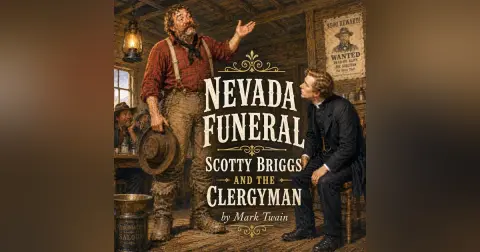
Frontier slang meets the King's English


Out in the Nevada mining camps of the 1870s, men learned to speak a language all their own, part slang, part swagger, part pure invention, and woe to the outsider who couldn't keep up. When a rough-hewn miner named Scotty Briggs marches into town to fetch a proper burial for a fallen friend, he finds himself face to face with a young, freshly minted clergyman who speaks only the King's English, and neither man has the faintest idea what the other is talking about. What follows is one of Mark Twain's funniest, and strangely most tender, character sketches, a collision of two American dialects, two worlds, and two men who, despite everything, manage to understand each other where it counts.
Before he was Mark Twain, he was Samuel Langhorne Clemens, a Missouri riverboat pilot who traded the Mississippi for the Nevada silver fields and, when the mining didn't pan out, picked up a pen instead of a pickaxe. He spent the 1860s knocking around the boomtowns of the Comstock Lode, filing dispatches for the Territorial Enterprise under a borrowed riverboat term, a leadsman's call meaning safe water, two fathoms deep. The camps he covered, and the characters who populated them, miners, con men, preachers, and everyone in between, gave him a lifetime's worth of material and an ear for the peculiar poetry of American speech. He'd go on to write the books that made him famous, but the West made him a writer first.
This is a episode from our archives recently remastered.
If you enjoyed this story, buy me an e-book!
https://www.buymeacoffee.com/donmcdonald
or take a no cost path: Follow the podcast so you never miss one
and if you enjoyed this story, a five-star rating or review helps others find us.
Think of it as applause without waking anyone.
Hosted on Acast. See acast.com/privacy for more information.